What Is Gaga Ball?
Gaga ball is a playground game in the dodgeball family, played inside a walled octagonal pit. Players slap a soft ball at each other with an open hand, and anyone hit on or below the knee steps out until the round ends. It is widely credited to Israel and reached North America through Jewish summer camps.
What actually happens in a game
Everyone climbs into the pit and puts a hand on the wall. Someone tosses the ball into the middle, the crowd shouts “Ga” on each of the first three bounces, and after the third the ball is live.
From there it is quick and loud. You hit the ball low along the floor with an open hand or a fist, aiming below other players’ knees. Get hit below the knee and you are out, so you step over the wall and wait. Catching and holding are not allowed, which keeps the ball moving constantly.
Rounds usually last two to five minutes. The last player standing wins, and the next round starts almost immediately, which is a large part of why children will play it for an hour without stopping.
Full breakdown: gaga ball rules ›
Why it is called gaga ball
The name comes from the Hebrew word ga (גע), which means touch. Say it twice and you get ga-ga, roughly touch touch, which describes the game accurately: you are touching the ball rather than throwing it.
You will see it written as gaga, ga-ga, gagaball and ga ga ball, and all four refer to the same game. The spelling varies by camp rather than by any rule.
The pit itself gets called a gaga pit, a gaga court, or an octopit when it has eight sides.
Where gaga ball came from
Gaga is consistently traced back to Israel. The Hebrew name, the arrival route through Jewish summer camps, and the game’s long presence in Israeli youth programmes all point the same direction, and every substantial source on the game says the same thing.
How it reached North America. Israeli counsellors working at Jewish summer camps in the United States brought the game with them, most accounts placing this in the 1970s. For decades afterwards it stayed inside that world. If you attended a JCC camp you knew gaga; if you did not, you had never heard of it.
When it escaped the camps. The spread beyond Jewish camps happened during the 2010s, moving first to other summer camps, then to church youth programmes, then to school playgrounds, parks and finally backyards. The retail market for pits that exists today is the last stage of that spread, and it is recent.
What nobody can actually tell you. No inventor is named anywhere. No founding year is documented. Accounts place the origin variously in the 1950s, the 1960s and the 1970s, and none of them cite a primary source. The game appears to have grown the way playground games usually do, through children changing rules that already existed, rather than through anyone inventing it on a particular afternoon.
That gap is worth stating plainly. Plenty of pages give a confident date. None of them show where the date came from.
Why it caught on so fast
Nobody needs to be good at it. There is no skill to learn before you can join. A small eight-year-old can knock out a teenager, and a low centre of gravity is an advantage rather than a handicap, which is the reverse of most playground sports.
Being out barely costs anything. Elimination games usually punish the weakest players by leaving them on the sidelines for the longest. In gaga the round ends in a couple of minutes and the next one starts straight away, so getting knocked out early means waiting ninety seconds.
No adult has to run it. Players call themselves out. There is no referee, no scoring and no equipment to hand out, which is why camps and schools like it so much: thirty children can occupy themselves in one pit while one adult watches from a distance.
Nothing gets thrown at anyone. The ball travels along the floor and gets struck rather than hurled. Several American school districts that removed dodgeball from the curriculum went on to install gaga pits, because the objection to dodgeball was about balls thrown hard at children’s heads, and gaga does not do that.
How it differs from dodgeball
| Gaga ball | Dodgeball | |
|---|---|---|
| Ball contact | Struck with hand or fist | Thrown |
| Ball height | Along the floor | Any height |
| Target area | Knee and below | Whole body |
| Playing area | Enclosed pit | Open court |
| Teams | Usually free-for-all | Two teams |
| Round length | 2 to 5 minutes | Until one side is out |
| Referee | Players call themselves out | Usually needed |
The family resemblance is real, and gaga is often introduced as a dodgeball variant. The differences that matter are the contact rule and the walls. Because the ball is slapped rather than thrown, it cannot be launched at somebody’s face, and because the walls keep it in play, the game never stops for someone to fetch it.
Is gaga ball a sport?
There is no international federation, no professional league, no standardised rulebook and no path to any championship. By any formal definition, gaga ball is a game rather than a sport.
What does exist is tournaments. Camps run them, schools run them at field days, and some communities hold them as fundraisers, but these are local events organised by whoever owns the pit. Rules differ between them, sometimes considerably.
The absence of a governing body is also why the rules vary so much from pit to pit. Nobody has the authority to settle whether the knee or the waist is the line, so each camp settles it themselves.
Other names for the game
Ga-ga and ga ga ball are the same game with the spelling spread out. Gagaball as one word is common in American schools. Israeli dodgeball appears occasionally, usually when someone is explaining the game to an audience that has never seen it. Octoball shows up in some equipment catalogues, referring to the eight-sided pit rather than to a different game.
The pit gets its own set of names: gaga pit, gaga court, gaga arena, octopit.
Where you will find a gaga pit
Summer camps remain the natural home of the game, and most American camps of any size now have a pit. Schools have been the fastest-growing category, usually installing one on the blacktop or in the gym for PE and recess.
Churches and community centres use them for youth programmes, and municipal parks have started adding them beside playgrounds. The newest category is private backyards, which is what created the retail market for portable pits over the last few years.
If you want to try the game before buying anything, a nearby camp, school or park is the likeliest place to find a pit already standing.
What you need to play
Two things: an enclosure with walls, and a ball.
The ball is an 8.5 inch playground ball, inflated soft enough to squeeze. Over-inflate it and every hit flies above the knee, which ends rounds in seconds.
The enclosure is where the money goes. Pits run from 10 to 25 feet across, with walls between roughly 23 and 36 inches, and they come as inflatables, fold-flat pop-ups, or commercial panels for schools and camps. Groups without a pit improvise walls from folding tables or benches, which works but plays slower.
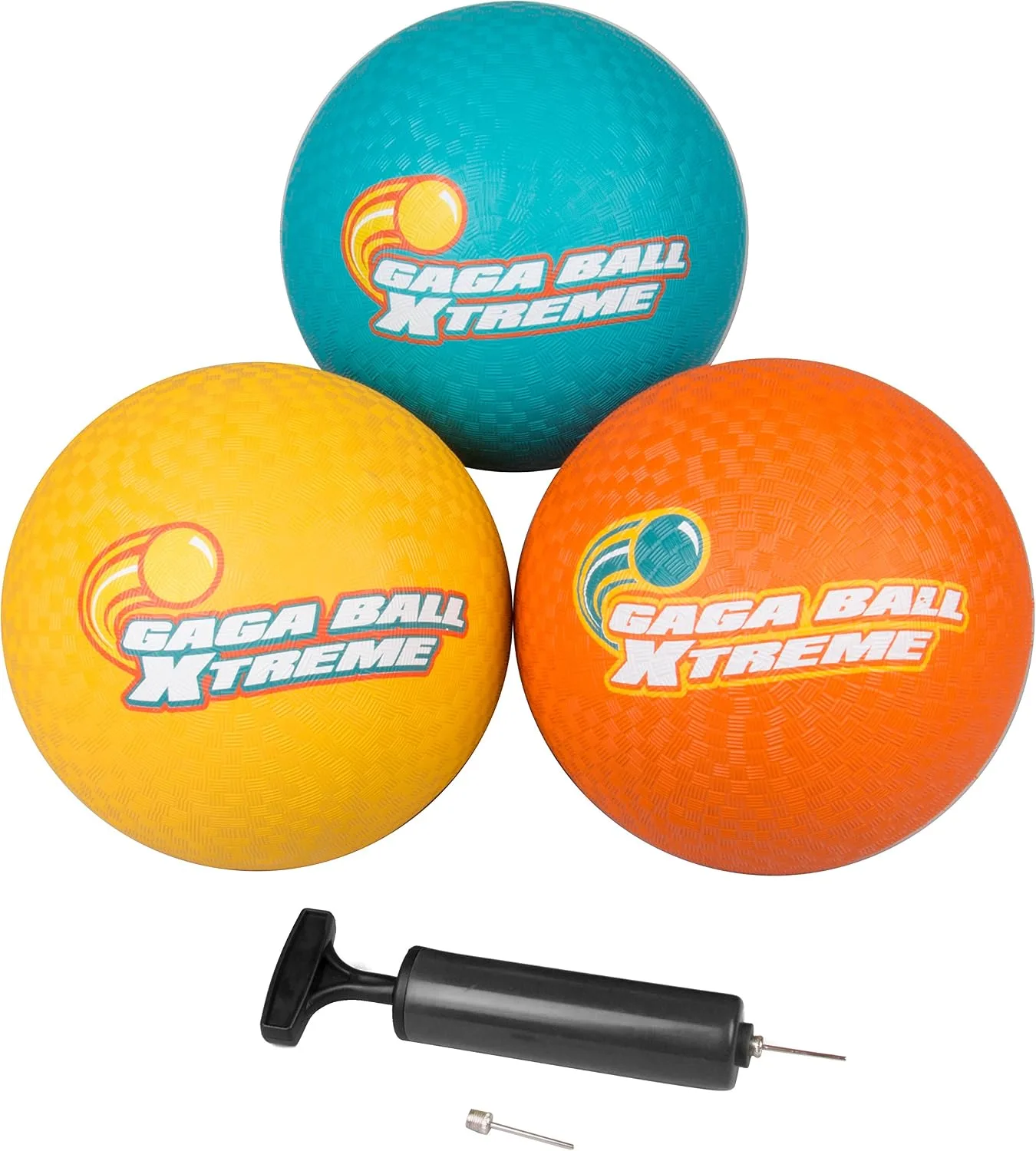
See gaga ball pits › Pit sizes ›
Frequently asked
What is the point of gaga ball?
To be the last player left in the pit. You do that by hitting the ball at other players below the knee while keeping your own legs out of its path.
Where did gaga ball originate?
Israel. It reached North America through Jewish summer camps, with most accounts placing the arrival in the 1970s.
Who invented gaga ball?
Nobody is named in any source. The game is credited to Israel, but there is no documented inventor and no agreed founding year.
Why is it called gaga ball?
From the Hebrew word ga, meaning touch. Doubled, ga-ga means roughly touch touch.
Is gaga ball Jewish?
The game came out of Israel and spread through Jewish summer camps, which is why many people first met it in that setting. The game itself carries no religious content and is now played in schools, parks and backyards everywhere.
What is the difference between gaga ball and dodgeball?
In gaga the ball is struck with a hand rather than thrown, it stays below the knee, and play happens inside a walled pit. Dodgeball is thrown, targets the whole body, and is played on an open court.
Is gaga ball an actual sport?
There is no federation, league or standard rulebook, so it is a game rather than a sport. Tournaments exist, but they are organised locally.
How many players can play gaga ball?
From two to about twenty-eight, depending on the size of the pit. Ten foot pits suit small groups; 25 foot pits handle a camp session.
Want to play at home?
Portable pits go up in minutes and pack into a bag. Here is what to look for.
We may earn a commission from purchases made through links on this page.